5 Best Short-Term Bond ETFs for Beginners (Blackrock)

Look, I get it – everyone’s obsessed with finding the next hot stock or crypto play. But here’s what nobody talks about enough: fixed income investing, specifically short-term bond ETFs.
I started focusing on short-term bonds after reading articles about Warren Buffett saying he invests heavily in T-bills when stocks are ridiculously expensive. That got me thinking – maybe it’s not wise to buy stocks when everything’s running hot. Plus, I learned that short-term bonds are the least risky products out there in addition to Money Market Funds since long-term bonds are exposed to serious duration risk that can cause a principal loss when you liquidate your funds at the wrong time.
Why Blackrock Bond ETFs

BlackRock offers a huge variety of bond ETFs that individuals can pick from, covering pretty much every duration and credit quality you can think of. I’m not entirely sure these are the absolute best ones out there, but they’re solid options with good liquidity and low expense ratios. There are definitely other providers like Vanguard and State Street that offer competitive alternatives, so don’t feel like you have to stick with just iShares.
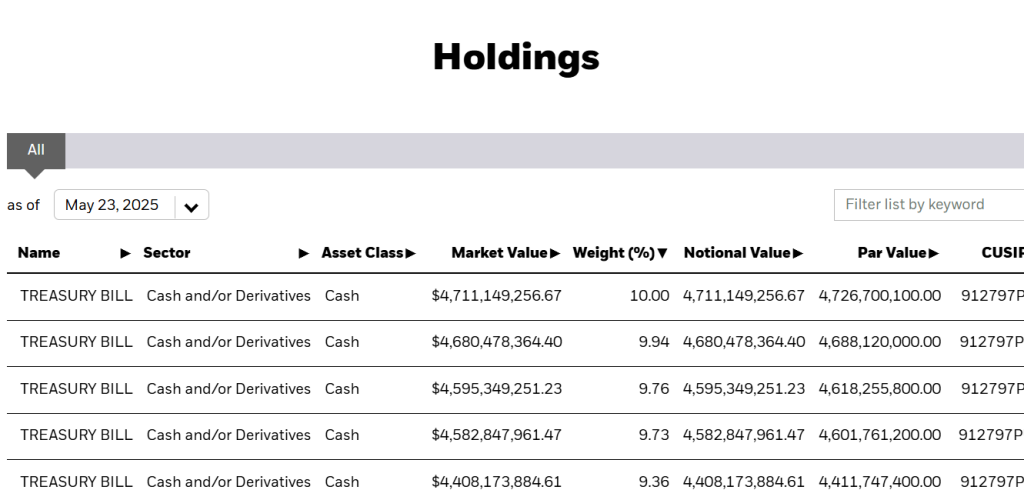
iShares 0-3 Month Treasury Bond ETFs (SGOV)
The iShares 0-3 Month Treasury Bond ETF holds treasury bills with 1-3 month maturities and a 0.09% expense ratio. It tracks the federal funds rate almost perfectly – when rates jumped in 2023, this ETF was yielding over 5% while maintaining rock-solid principal stability. So if you invest $10,000, you’d make about $500 in dividends while paying just $9 in management fees – though remember that’s the gross number, not net after taxes. The net asset value rarely moves more than a few cents, making it incredibly predictable.
iShares 1-3 Year Treasury Bond ETFs (SHY)
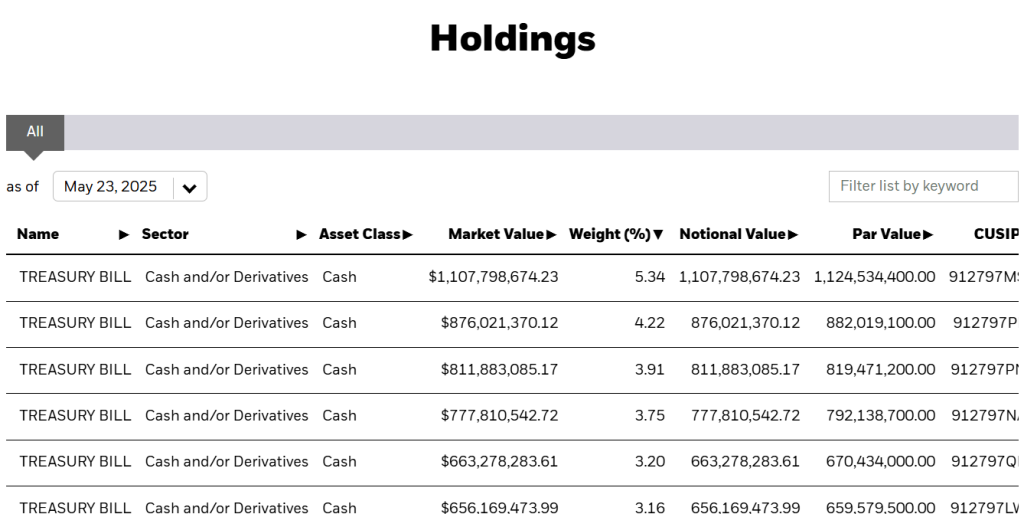
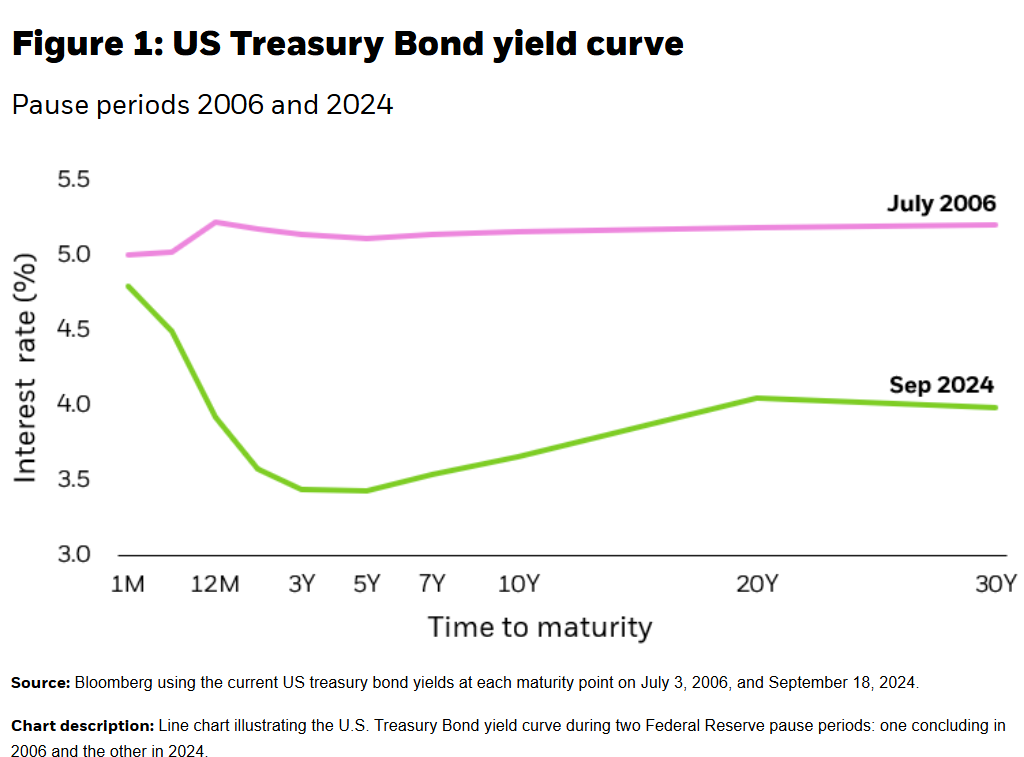
iShares 1-3 Year Treasury Bond ETF extends duration slightly with 1-3 year maturities, typically (NOT ALWAYS) yielding 0.3-0.7% more than SGOV due to that extra tenor risk compensation. When rates fall, SHY benefits from capital appreciation because its longer-duration bonds (1-3 years) hold onto higher yields longer than SGOV’s ultra-short portfolio, which gets replaced with new lower-rate securities within months.
I learned that even short-term bonds have interest rate sensitivity – SHY dropped about 1.8% during aggressive Fed hiking before recovering. Unlike SGOV’s penny movements, SHY’s NAV can fluctuate more than a dollar; for example, it lowered to $75.33 in July 2023 during that rising rate environment ($82.46 as of May 23, 2025).

iShares Short Treasury Bond ETFs (SHV)
iShares Short Treasury Bond ETF targets securities under 12 months maturity, usually averaging 6-7 months. This provides a nice balance between income and stability, less volatile than SHY but potentially higher-yielding than SGOV in a normal rate environment. With a 0.15% expense ratio, your $10,000 would generate around $450 in dividends while costing $15 in management fees.
Treasury Bond ETFs Yields Comparison – Calendar Year 2025
| ETF Ticker | Fund Name | Maturity Range | Average Yield 2025 | YTD Return 2025 | Expense Ratio |
| SGOV | iShares 0-3 Month Treasury Bond ETF | 0-3 months | ~4.70-4.79% | 1.68% | 0.09% |
| SHV | iShares Short Treasury Bond ETF | 0-12 months | ~4.05-4.78% | 1.58-1.60% | 0.15% |
| SHY | iShares 1-3 Year Treasury Bond ETF | 1-3 years | ~3.94-3.95% | 1.88-1.93% | 0.15% |
One thing I wish I’d known: these ETFs distribute monthly dividends that vary with prevailing rates.
iShares Short Duration Bond Active ETFs (NEAR)
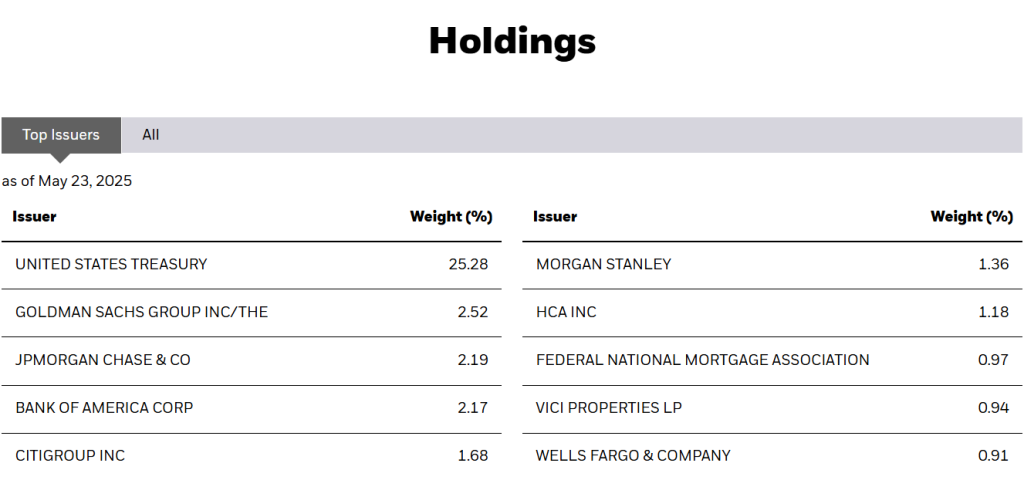
iShares Short Duration Bond Active ETF operates as a tactical bond fund with ~1.9 years duration, holding 1,089 securities split between 39% US government bonds and 61% corporate/other bonds (including investment-grade corporates, asset-backed securities, and diversified bonds). The 0.25% expense ratio is higher – so $25 annually on $10,000 – but the flexibility can outperform during volatile periods.
iShares Ultra Short Duration Bond Active ETFs (ICSH)
iShares Ultra Short Duration Bond Active ETF functions more as a cash parking solution with ultra-short duration under one year, focusing on investment-grade corporate bonds, money market instruments, and cash equivalents. At 0.08% expense ratio, you’d pay just $8 in fees on $10,000, making it ideal for cash management with slightly better yields than traditional money market funds.
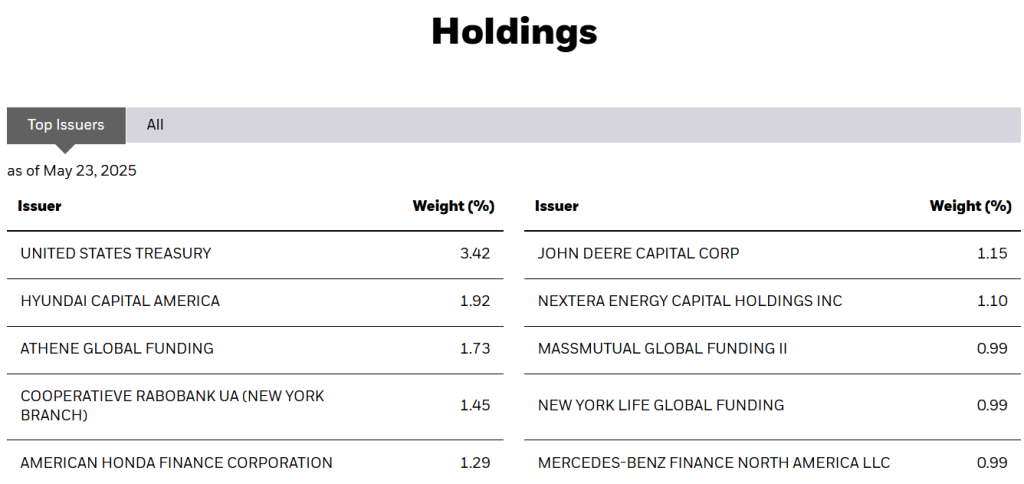
The clear difference between these two active funds and the others is asset allocation – NEAR and ICSH invest in corporate bonds which provides higher yields adding a little risk, whereas SGOV, SHY, and SHV stick purely to government securities.
Bottom line: I prefer SGOV bond ETFs if you’re not actively seeking maximum returns but looking for passive income that’s much higher than savings accounts. While SHY offers duration advantages during falling rates and NEAR/ICSH provide corporate bond exposure for extra yield, SGOV delivers the perfect balance of simplicity and performance for most investors. You get money market-like stability with treasury bill yields that blow away any high-yield savings account, plus the liquidity to access your funds instantly. Sometimes the best investment strategy isn’t about squeezing out every last basis point – it’s about getting solid, predictable returns without the headache of timing interest rate cycles or worrying about credit risk.
Understanding Bond ETFs: The Basics You Need to Know
Honestly, I wish someone had explained bond ETFs to me years ago in plain English instead of throwing around all that Wall Street jargon. I remember sitting in the college classroom feeling completely lost when professors started talking about duration and yield spreads – it was like they were speaking another language entirely.
Bond ETFs – Baskets of Bonds that Trade like Stocks
Think of it this way: instead of buying individual bonds from companies or the government, you’re buying a slice of a huge portfolio that holds hundreds or thousands of bonds with different maturity dates – some might mature in 6 months, others in 2 years, creating a diversified mix. Compare that to buying a single bond which has just one specific maturity date, like a 10-year Treasury that matures exactly on January 15, 2034. The ETF does all the heavy lifting – they buy the bonds, collect the interest payments, and pass them along to you as dividends.
Here’s where I made my first big mistake – thinking bond ETFs and individual bonds were basically the same thing. They’re not, and the differences matter more than you’d think. When you buy an individual bond, there’s no principal loss as long as you hold it until the maturity date – you’ll get your full investment back regardless of what interest rates did in between. With bond ETFs, there’s no maturity date because the fund keeps replacing old bonds with new ones as they mature, which means you can suffer a principal loss if you pull out your money at the wrong time when rates have moved against you.
I learned that bond ETFs fluctuate in value when I researched the NAV and saw the 52-week range was more than a dollar. This became painfully clear during a rising rate environment when my bond ETF kept dropping in value while individual bondholders just waited for their bonds to mature at full value.
Bond ETFs vs Money Market Funds
Take SGOV versus VMFXX (Vanguard’s Federal Money Market Fund) – this is a more apple-to-apple comparison since both focus on ultra-short government securities. While the expense ratio difference isn’t huge between these two, there are some key elements to consider.
Here’s what makes the difference:
- Intraday liquidity with SGOV means you can buy and sell during market hours instead of waiting for end-of-day pricing while you can withdraw money from VMFXX only after markets close (typically around 4PM EST).
- SGOV is an ETF, which could be taxed on its capital gains. On the other hand, VMFXX is very tax efficient at default because SEC’s strict rule on the Money Market Fund’s NAV deviation limit keeps its value constant and only distribute interest income (dividends) from its investment into US Treasuries. However, because SGOV’s price movement is almost negligible, there is not much tax advantage between the two under normal circumstances.
- It really comes down to your investment style too – some people prefer the flexibility of trading ETFs and having that stock-like control, while others just want to park their money in a money market fund and forget about it.
In a nutshell, when you are considering investing in either money market funds or bond ETFs, you should also take into account other factors (intraday liquidity, capital gain tax advantage) in addition to yields and expense ratio.
Duration is the metric that’ll make or break your bond investing success. Duration measures how sensitive a bond fund is to interest rate changes – higher duration means bigger price swings when rates move. I used to ignore this completely until 2022 taught me a huge price swing in long-duration bond funds during rising rates while working as a Fixed Income sales.
A duration of 5 years means that for every 1% increase in interest rates, the fund’s price drops about 5%. So when rates jumped from 1% to 4%, those long-term bond ETFs got absolutely hammered.
Yield is trickier than it looks because there’s SEC yield (the standardized 30-day yield) and distribution yield (what you actually received recently). SEC yield is more reliable for comparing funds, but distribution yield shows you what’s been happening lately with actual payments.
Conclusion
Income distribution is where bond ETFs really shine for those worried about stock market fluctuations and seeking diversification through fixed income. Most pay monthly dividends, though some quarterly, and the amount fluctuates based on what the underlying bonds are earning. Unlike stock dividends that companies can cut arbitrarily, bond ETF distributions are tied directly to the interest payments from the bonds they hold, giving you that steady income stream that’s completely separate from equity market drama.
When investing in bond ETFs, don’t panic even if the NAV drops because you’re still getting that interest income in the form of dividends. When the rate environment eventually moves in your favor, it will recover the principal loss over time. The key is focusing on earning extra bucks using your surplus cash that you’d otherwise park in a savings account – not trying to take advantage of market swings to get rich quick.