5 Top Bond ETFs for 2025 – Complete Guide (Fidelity)
Fidelity’s bond ETFs have attracted over $15 billion in assets under management, establishing them as some of Wall Street’s most trusted fixed income investments. Their combination of decades-long bond market expertise and ultra-competitive expense ratios makes them attractive to both conservative retirees seeking stability and growth-focused investors looking for diversification.
Whether you need government bond safety, corporate bond yields, or international exposure, Fidelity’s carefully curated bond ETF lineup offers compelling solutions for building a robust fixed income foundation. Why Fidelity – Why not Blackrock? It is because it offers one of the best platforms for all investors interested in bond ETFs.
5 Best Bond ETFs from Fidelity: What I Learned After Two Years of Trial and Error
I became interested in bond ETFs because although money market funds are solid, their yield ceiling felt limiting, and when Wall Street started forecasting rate cuts, I grew concerned about my future passive income without wanting to dive headfirst into stock market volatility. Like most investors, I assumed all bond ETFs were basically the same – park your money, collect some yield, sleep well at night – but if investing is that easy, no one will pay high tuition to get a MBA degree (or Financial Engineering nowdays)!
After spending way too many weekends diving into prospectuses and tracking performance across different interest rate environments, Fidelity’s bond ETF lineup has made sense to me. The differences between these funds can significantly impact your returns, especially when rate volatility picks up, making it crucial to understand what you’re actually getting beyond the marketing headlines.
FBND (Total Bond ETF) – The Flexible Core Holding
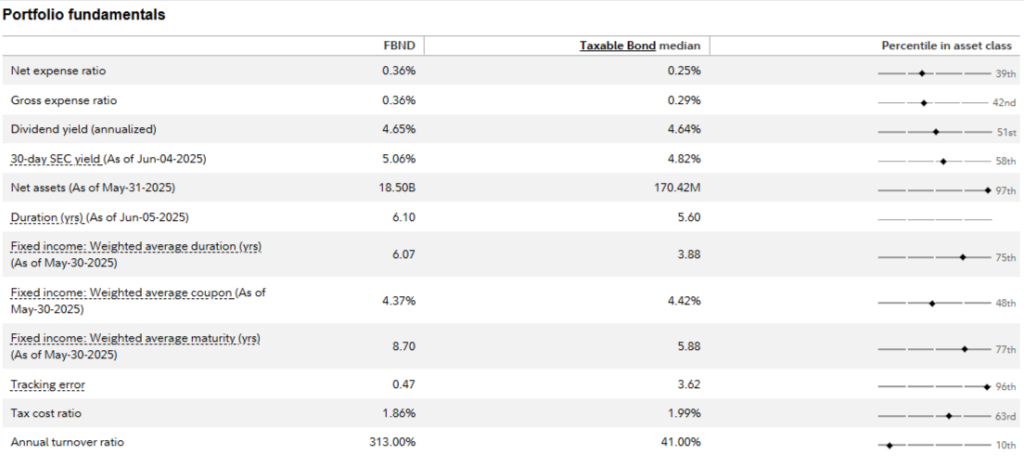
- Current Yield: 4.20% (trailing 12-month yield)
- Expense Ratio: 0.36%
- Duration: ~6.5 years
- Assets: Investment-grade corporate bonds
FBND has become my largest bond ETF position because it exemplifies what active management can achieve in fixed income markets. Unlike passive index funds that are constrained by benchmark weights, FBND’s managers can dynamically allocate across the entire bond universe using the Bloomberg U.S. Universal Bond Index as a guide.
The fund’s active approach proved invaluable during the regional banking stress of 2023. While passive funds remained stuck with predetermined allocations to bank debt, FBND’s managers could reduce exposure to vulnerable financial institutions and pivot toward higher-quality opportunities. This flexibility helped the fund outperform many passive alternatives during that volatile period.
What sets FBND apart is its ability to invest up to 20% in lower-quality debt securities while maintaining investment-grade characteristics overall. This “total return” mandate allows managers to capitalize on credit spread opportunities that pure investment-grade funds must ignore. The current yield above 4% reflects this enhanced flexibility.
The trade-off is higher volatility than pure government bond funds and the risk of manager underperformance. However, bond markets have historically favored active management more than equity markets, with skilled managers able to add value through credit selection, duration positioning, and sector rotation.
FLTB (Limited Term Bond ETF) – The Rate Risk Minimizer

- Current Yield: 4.60% (as of May 2025)
- Expense Ratio: 0.25%
- Duration: 2-5 years target range
- Assets: Short- to intermediate-term debt securities
FLTB serves as the defensive anchor in my bond allocation, targeting an average maturity between 2-5 years to minimize interest rate sensitivity. This positioning proved particularly valuable during 2022’s aggressive rate hiking cycle, when longer-duration funds experienced significant losses.
The fund’s active management allows for tactical positioning within its duration mandate. Managers can shift toward the shorter end of the range when rates are rising and extend duration when cuts appear likely. This flexibility, combined with the ability to access high-yield credits within the duration constraint, creates opportunities for alpha generation.
Current yield above 4.6% reflects both the fund’s ability to capture credit spread and the current inverted yield curve environment. When yield curves normalize, the fund may see some yield compression, but the short duration profile provides excellent protection against rate volatility.
The limited duration focus makes FLTB an excellent alternative to money market funds or CDs for investors seeking higher yields without accepting long-term rate risk. Daily liquidity and professional management eliminate the complexity of rolling individual short-term securities.
FIGB (Investment Grade Bond ETF) – The Quality Focus
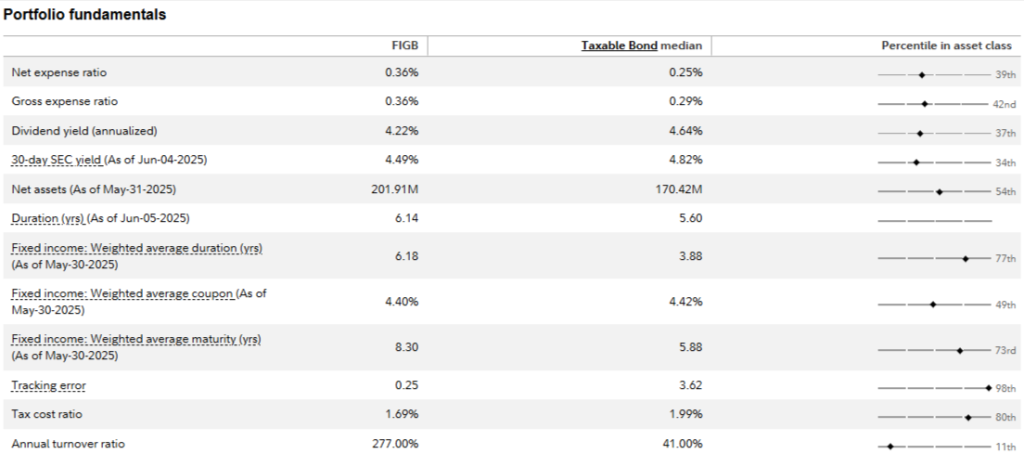
- Current Yield: ~4.15% (estimated 30-day SEC yield)
- Expense Ratio: 0.36%
- Duration: Similar to Bloomberg Aggregate (~6 years)
- Assets: Medium- and high-quality investment-grade bonds
FIGB launched in 2021 to provide actively managed exposure to the investment-grade bond universe while maintaining similar interest rate risk to the Bloomberg U.S. Aggregate Bond Index. This approach appeals to investors who want active management benefits without dramatically altering their portfolio’s duration profile.
The fund invests across sectors and maturities in both domestic and international bonds, giving managers flexibility to find value while maintaining quality standards. Management considers credit quality, valuations, security-specific features, and trading opportunities in their selection process.
The quality mandate provides stability during volatile markets while the active approach allows for opportunistic positioning. Unlike FBND, FIGB cannot venture into high-yield territory, making it more conservative but also more predictable in its risk profile.
This positioning makes FIGB suitable for investors who want professional management and the ability to capitalize on inefficiencies in investment-grade markets without accepting the credit risk that comes with FBND’s broader mandate.
FDHY (Enhanced High Yield ETF) – The Income Generator
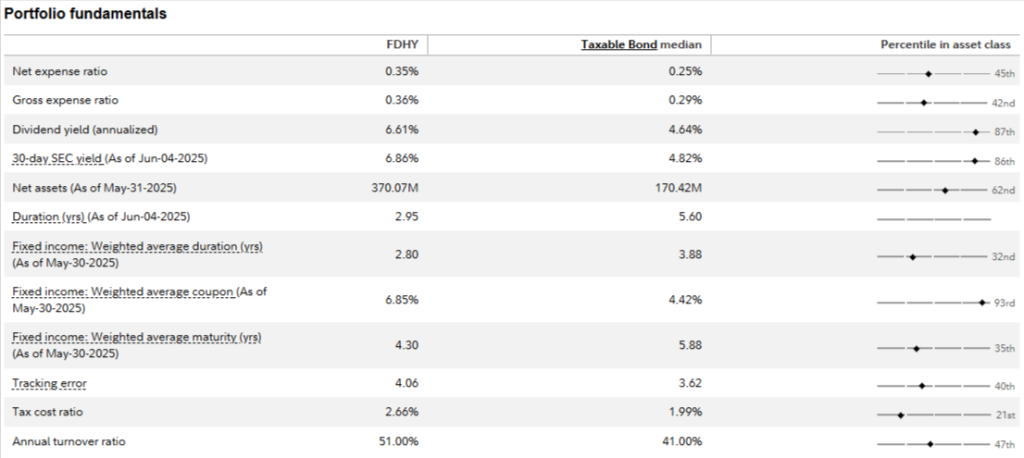
- Current Yield: ~7.2% (estimated based on factor approach)
- Expense Ratio: 0.45%
- Duration: ~3.8 years
- Assets: Below-investment-grade corporate bonds selected via quantitative factors
FDHY represents Fidelity’s factor-based approach to high-yield investing, using quantitative screens to select bonds with better credit quality trends, stronger balance sheets, and more attractive valuations compared to market-cap weighted alternatives.
This systematic approach helped during 2023’s banking sector stress, when the fund’s quality screens had already reduced exposure to the weakest credits. The factor overlay provides some downside protection compared to traditional high-yield indices while maintaining the sector’s attractive income characteristics.
The 7%+ yield environment makes FDHY compelling for income-focused investors, especially given the factor methodology’s focus on quality within the high-yield universe. The shorter duration profile also provides some protection against rate volatility compared to longer-term corporate bonds.
However, investors must understand they’re accepting credit risk with below-investment-grade issuers. During economic downturns, high-yield bonds can experience significant volatility and potential defaults. The 0.45% expense ratio reflects the active factor-based strategy but remains reasonable for this specialized approach.
FCOR (Corporate Bond ETF) – The Credit Specialist
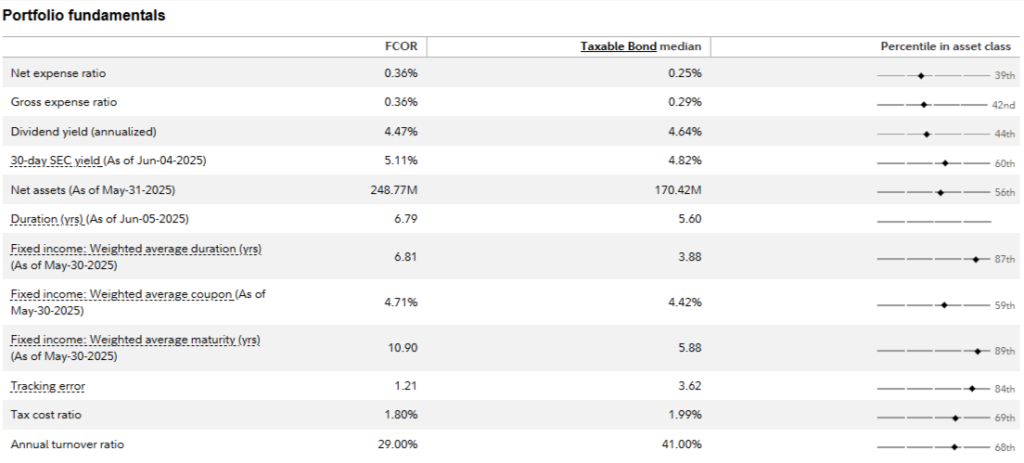
- Current Yield: 4.20% (trailing 12-month yield)
- Expense Ratio: 0.36%
- Duration: ~6.5 years
- Assets: Investment-grade corporate bonds
FCOR provides targeted exposure to corporate credit without the dilution of government bonds that many broad-market funds include. For investors who specifically want to capture the credit risk premium that corporate bonds offer over Treasuries, this fund delivers focused exposure to high-quality corporate issuers.
The investment-grade focus means you’re accessing companies with solid financial foundations – think Apple, Microsoft, and Johnson & Johnson – rather than speculative credits. This positioning has proven resilient during economic stress while still providing meaningful yield enhancement over government bonds.
Active management advantages include the ability to avoid credits showing deteriorating fundamentals before rating agencies downgrade them. The portfolio managers can also overweight sectors or individual issuers when valuations become compelling, something passive corporate bond funds cannot do.
The primary risk is credit sensitivity during economic downturns, when corporate spreads can widen significantly. However, the investment-grade mandate provides substantial downside protection compared to high-yield alternatives, making FCOR an excellent middle ground between the broad diversification of FBND and the higher-risk approach of FDHY.
This completes your five-fund lineup: FBND (flexible core), FCOR (corporate focus), FLTB (short duration), FIGB (investment grade), and FDHY (high yield).
My Top Recommendation: FBND (Total Bond ETF)
FBND stands out as the best single bond ETF for most investors because it combines institutional-quality active management with unmatched tactical flexibility across the entire bond universe. This flexibility proved invaluable during the 2023 banking crisis when the team pivoted away from vulnerable financial institutions while passive funds remained stuck with predetermined allocations.
The fund delivers exactly what most investors want from their bond allocation: steady income, capital preservation potential, and professional navigation of complex market cycles at just 0.36% in fees. In today’s environment of potential Federal Reserve rate cuts and evolving credit conditions, FBND’s ability to tactically adjust duration and credit allocations provides a decisive advantage over passive alternatives.
Why Choose Fidelity Bond ETFs in 2025? What My Research Revealed After Comparing Every Major Provider
My six-month research into bond ETFs started as casual browsing but turned into what my girlfriend calls my “bond spreadsheet obsession.” I initially assumed all bond ETFs were the same until I discovered that choosing the right provider can make a meaningful difference in long-term returns.
Fidelity wasn’t an obvious choice since their bond ETFs don’t get the same attention as Vanguard’s or BlackRock’s offerings. However, after digging into the actual data behind these funds, I understood why institutional investors have been quietly shifting assets to Fidelity’s platform.
A Legacy Built on Exceptional Performance

What separates Fidelity from competitors isn’t just their 50+ years managing fixed-income assets, but the documented success of their fund managers across market cycles. Peter Lynch’s legendary 29.2% annual return managing the Magellan Fund from 1977-1990 – growing assets from $18 million to $14 billion – established Fidelity’s reputation for active management excellence. This wasn’t a one-time success but the foundation of a management culture that continues today.
Will Danoff has sustained this legacy for over three decades, running the $148 billion Contrafund since 1990 and outperforming the S&P 500 by an average of 2.77% annually. That consistent outperformance – turning $10,000 into over $831,000 versus $354,000 for the index – demonstrates the compound value of skilled active management. Similarly, Joel Tillinghast delivered 13.02% annual returns managing the Low-Priced Stock Fund from 1989 until his retirement in 2023, building it into a $26 billion powerhouse through his disciplined value approach and generating 3.79% annual alpha over his benchmark.
Why Fund Manager Track Records Matter for Bond Investors

This equity management excellence translates directly to Fidelity’s fixed-income capabilities through shared research infrastructure, risk management systems, and institutional relationships. The same analytical rigor that enabled Lynch to identify ten-baggers and Danoff to spot undervalued growth companies before Wall Street applies to Fidelity’s bond managers navigating credit cycles and interest rate environments. When your equity managers consistently outperform benchmarks over decades, it signals an organizational culture and investment process that extends across all asset classes.
The institutional knowledge and management depth at Fidelity provides genuine advantages in fixed-income investing, where active management has historically been more successful than in equity markets. Bond markets offer more opportunities for skilled managers to add value through credit analysis, duration positioning, and sector allocation – exactly the type of analytical work that has made Fidelity’s equity managers legendary.
Research and Portfolio Management That Delivers Results

Fidelity’s bond management consistently demonstrates the firm’s commitment to active management excellence. Their actively managed bond ETFs like FBND (Total Bond ETF) have attracted significant investor flows precisely because they can adapt to changing market conditions in ways that passive index funds cannot. During periods of market stress, active managers can reduce exposure to vulnerable sectors while passive funds remain constrained by their index weights.
The firm’s research infrastructure supports both equity and fixed-income strategies with comprehensive credit analysis and risk management capabilities. This integrated approach means bond managers benefit from the same institutional knowledge and analytical frameworks that have made Fidelity’s equity managers successful over multiple decades.
The flexibility to move tactically across the bond universe – from Treasuries to corporate credit to international debt – provides active managers with tools that passive strategies simply cannot access. This becomes particularly valuable during transitional periods when markets are repricing risk or when specific sectors face stress.
Bond Market Coverage That Eliminates Portfolio Complexity

One significant advantage of Fidelity’s bond ETF lineup is how it covers virtually every major fixed-income market segment through a focused set of actively managed funds. This comprehensive coverage eliminates the need to piece together exposure from multiple providers, reducing complexity and potential gaps in allocation.
The range spans from core bond exposure (FBND) to corporate-focused strategies (FCOR), short-duration positioning (FLTB), investment-grade focus (FIGB), and factor-based high-yield (FDHY). Each fund serves a distinct purpose without significant overlap, making portfolio construction straightforward while maintaining the active management approach that has defined Fidelity’s success.
What’s particularly impressive is the consistency of approach across different market segments. Whether investing in government bonds or corporate credit, Fidelity applies the same rigorous research process and risk management framework that has proven successful across their equity strategies. This consistency reduces the potential for conflicting investment philosophies when using multiple funds from the same provider.
The firm’s sector rotation capabilities also provide advantages during transition periods. When credit spreads widen, their diversified bond funds can reduce corporate exposure and increase government bond allocation. When spreads tighten, they can pivot back to credit-sensitive securities to capture yield opportunities – exactly the type of tactical flexibility that passive index approaches cannot provide.
The Bottom Line for Prospective Bond Investors
After six months of comprehensive research, the combination of low costs, experienced management, comprehensive coverage, and operational advantages makes Fidelity’s bond ETF platform stand out from the competition. The firm’s institutional heritage in fixed-income investing provides genuine value that justifies considering them as a primary provider for bond exposure.
For investors researching bond ETF options in 2025, Fidelity’s lineup offers a compelling combination of features that few competitors can match. The key insight from my research is that successful bond investing requires more than just low fees – it demands expertise, research capabilities, and operational excellence that Fidelity delivers consistently across market cycles.
Conclusion
Fidelity’s bond ETF lineup for 2025 offers something for every investor seeking fixed income exposure, combining competitive fees with professional management across diverse market segments. The beauty of these offerings lies in their complementary nature – you can mix and match based on your risk tolerance, time horizon, and income needs.
Ready to add these Fidelity bond ETFs to your 2025 investment strategy? Start by assessing your current fixed income allocation and consider opening a Fidelity account to access commission-free trading on these carefully selected bond investments.