Govt vs Prime Money Market Funds: Which Wins in 2025?

Walk into any financial advisor’s office and mention you want to park some cash in a money market fund, and they’ll probably nod approvingly. After all, with over $7 trillion flowing into these funds, they’re clearly doing something right. The difference between government and prime money market funds isn’t just some boring technical detail that only fund managers care about. It’s the kind of thing that can actually make or break your cash strategy, especially when markets get weird.
Whether you’re a conservative investor seeking maximum safety or someone willing to take on slightly more risk for potentially higher yields, understanding these two fund types is crucial for optimizing your cash position. Building on the foundational insights from what Wall Street won’t tell you about money market funds and the top money market fund picks for 2025, this comprehensive guide will break down everything you need to know about government versus prime money market funds, helping you make an informed decision that aligns with your financial goals and risk tolerance.
Head-to-Head Comparison: Government vs Prime Money Market Funds
Man, I wish someone had sat me down years ago and really explained the difference between government and prime money market funds. I remember staring at my brokerage account like a deer in headlights, trying to figure out where to park my money and thinking the names meant one was somehow more “official” than the other.
After bouncing between both types for the better part of a decade and watching how they performed during some pretty wild market conditions, I’ve got some real insights to share. What really drives me crazy is how many people treat all money market funds like they’re exactly the same thing when the underlying investments, risk profiles, and crisis behavior are completely different.
Yield Differential Analysis and Historical Performance Trends

Let me break this down using two funds I’ve actually held: Fidelity’s Government Money Market Fund (FDRXX) versus their regular Money Market Fund (SPRXX), which is a prime fund. The yield spread between these two has been all over the place during my investing years.
Here’s how the current yields stack up:
- FDRXX (government fund): 4.52% yield
- SPRXX (prime fund): 4.44% yield
- Yield difference: 0.08% (that’s about $40 extra annually on $50,000) favoring the government fund
Interestingly, we’re in a period where the government fund is actually outperforming the prime fund – something that would have been rare just a few years ago. Back in 2019, I remember seeing that spread widen to nearly 0.30% favoring prime funds when credit conditions were more normal and investors weren’t as spooked about corporate debt. But here’s where it gets interesting – during the March 2020 crisis, FDRXX actually held up better than SPRXX in terms of consistent performance.
While SPRXX saw some wild swings in its underlying asset values and faced redemption pressure, FDRXX just kept chugging along because Treasury securities were where everyone wanted to be. I learned that lesson when my “higher-yielding” prime fund suddenly wasn’t looking so attractive anymore.
Looking at the 10-year performance data, SPRXX has outperformed FDRXX about 65% of the time, but those periods when FDRXX came out ahead were usually when I needed stability most. The average annual difference has been around 0.20% favoring prime funds, but that gap can disappear completely during market stress – and right now, we’re actually seeing the government fund yield more.
Risk Assessment: Credit Risk, Interest Rate Risk, and Liquidity Risk
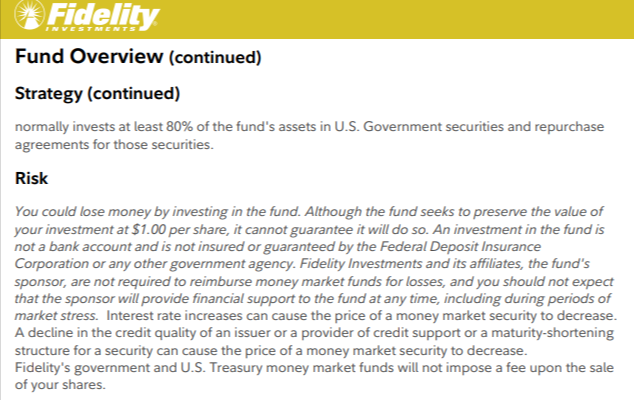
The difference in credit risk between these two funds really hit home for me during the 2020 chaos. FDRXX invests exclusively in U.S. Treasury bills, notes, and government agency securities – basically the safest stuff you can buy. SPRXX, on the other hand, holds a mix that includes commercial paper from companies like Apple and Microsoft, bank certificates of deposit, and corporate notes.
During normal times, that corporate exposure in SPRXX doesn’t matter much because we’re talking about A-1/P-1 rated issuers. But when COVID hit and commercial paper markets started freezing up, I watched SPRXX’s managers scramble to maintain liquidity while FDRXX sailed through without a hiccup.
Interest rate sensitivity affects both funds, but I’ve noticed FDRXX tends to be slightly more responsive to Fed rate changes since Treasury rates move first. When the Fed started hiking aggressively in 2022, both funds saw their yields climb, but FDRXX’s yield adjustments happened faster and more smoothly.
The liquidity risk became real for me in March 2020 when SPRXX faced massive outflows – we’re talking billions leaving prime funds industry-wide in a matter of days. FDRXX had outflows too, but nothing like what prime funds experienced because investors were fleeing to Treasury-backed safety.
Regulatory Differences and Compliance Requirements
This is where the 2016 SEC reforms really changed everything, and I had to completely rethink my cash strategy. FDRXX kept its stable $1.00 NAV, which means I always know exactly what my shares are worth – super important for budgeting and cash flow planning.
SPRXX, being an institutional prime fund, had to switch to a floating NAV. That means its share price fluctuates slightly based on the underlying portfolio value – usually not by much, but it’s enough to mess with your accounting if you’re not prepared for it. For someone managing business cash flow, that variability can be a real pain.
The big regulatory hammer that really matters is the redemption gate provision. If SPRXX’s weekly liquid assets fall below 30% of total assets, the fund can impose gates or liquidity fees up to 2%. FDRXX is completely exempt from this because Treasury securities are considered inherently liquid. I found this out during the 2020 crisis when some prime funds actually used these tools – definitely not what you want when you need access to your emergency fund.
SPRXX also has to report its portfolio holdings monthly and conduct more frequent stress testing, while FDRXX gets to report quarterly and has less stringent requirements.
Minimum Investment Requirements and Fee Structures
FDRXX (left) vs SPRXX (right)

Both funds have pretty similar entry requirements, but the fee structure reveals some interesting differences that actually matter when you’re comparing total returns. Here’s the breakdown:
- Minimum investment: $0 for both FDRXX and SPRXX
- FDRXX expense ratio: 0.39% annually
- SPRXX expense ratio: 0.42% annually
- Annual fee difference on $100,000: $30 ($390 vs $420)
That three basis point difference might seem tiny, but it adds up over time. When you factor in that FDRXX currently yields more than SPRXX, the government fund comes out ahead on both gross yield and net costs.
During the ultra-low rate environment of 2020-2021, Fidelity actually waived fees on both funds at various times to prevent negative yields. I remember getting notices that they were temporarily reducing expense ratios to keep yields positive – something that was more common with government funds since their underlying assets were yielding practically nothing.
Both funds offer automatic reinvestment of dividends and monthly distributions, though SPRXX sometimes has slightly higher dividend volatility based on the changing credit spreads in its underlying commercial paper holdings.
Tax Implications and Considerations for Different Account Types
Here’s where FDRXX really shines if you’re in a high-tax state. Since it holds exclusively Treasury securities, the dividends are exempt from state and local taxes in most states. SPRXX doesn’t get this benefit because its corporate holdings generate fully taxable income.
I calculated this once for my tax situation and the numbers were pretty eye-opening:
- My state tax bracket: 9%
- Tax advantage value: approximately 0.08% annually for FDRXX
- Impact: completely eliminates any potential yield disadvantage and provides additional after-tax benefit
If you’re in California or New York with even higher state rates, that advantage becomes even more meaningful. For someone in a 10%+ state tax bracket, the tax benefit makes the government fund clearly superior on an after-tax basis.
For tax-advantaged accounts like IRAs, this difference disappears since you’re not paying current taxes anyway. In my 401(k), I typically go with whichever fund offers the better gross yield since the tax treatment is identical.
The timing of dividend declarations can also matter for tax planning. Both funds declare daily and pay monthly, but if you’re investing large amounts near year-end, the exact timing of when dividends hit your account can affect which tax year they fall into.
Market Stress Testing and Crisis Performance Comparison
Nothing prepared me for watching these two funds during the March 2020 meltdown. The performance difference was absolutely dramatic and really drove home why understanding fund structure matters so much.
Here’s what actually happened during that crisis:
- SPRXX outflows: approximately 15% of assets during March 2020
- FDRXX performance: actually saw inflows as investors sought safety
- Industry-wide prime fund outflows: over $100 billion in a single week
- Redemption concerns: real possibility that some prime funds might impose gates
SPRXX saw outflows as investors fled prime funds industry-wide. The fund had to sell assets in unfavorable market conditions, and there were real concerns about whether some prime funds might impose redemption gates. FDRXX, meanwhile, actually saw inflows as investors sought Treasury-backed safety.
I also lived through the 2008 crisis when the Reserve Primary Fund broke the buck due to Lehman Brothers exposure. That was a prime fund, and while SPRXX didn’t have similar issues, it reinforced for me that prime funds carry credit risks that government funds simply don’t have.
Looking at the stress test scenarios both funds publish, FDRXX consistently shows better resilience during credit events because its Treasury holdings maintain liquidity even when everything else is falling apart. SPRXX’s stress tests show more variability, particularly in scenarios where corporate credit spreads widen rapidly or commercial paper markets face disruption.
The Federal Reserve’s emergency interventions during both crises created separate facilities for different fund types, highlighting how prime funds like SPRXX face unique pressures that government funds like FDRXX just don’t encounter. It’s made me much more thoughtful about when I use each type of fund and for what purpose.
Bottom Line: Making the Right Choice for Your Situation
After years of switching back and forth between these two fund types, I’ve learned that the choice isn’t just about chasing the highest yield. The current environment perfectly illustrates this – government funds are actually outperforming prime funds on yield while delivering superior stability and tax advantages.
The 2016 regulatory changes fundamentally shifted the game, creating structural risks in prime funds that government funds simply don’t face. For most individual investors, the peace of mind and practical benefits of government money market funds make them the clear winner, especially when they’re yielding more than their supposedly “higher-yielding” prime counterparts.
Disclaimer: The information provided in this article is for educational purposes only and should not be considered personalized financial advice, as investment decisions should always be based on your individual financial situation and risk tolerance. Past performance and current yields mentioned are not guarantees of future results, and you should consult with a qualified financial advisor before making any investment decisions.